What Are the Top Decorative Boards in 2026?
Choosing the right Decorative Boards in 2026 means balancing appearance, durability, indoor use, and cost. A matte oak veneer can warm a compact kitchen, while high-pressure laminate may better handle busy counters and frequent cleaning. MDF, particleboard, plywood, and laminated panels each perform differently. There is no single winner for every room. Details matter. This guide compares leading options by finish, moisture resistance, maintenance, and typical application, rather than treating attractive samples as proof of long-term performance.
The evidence also deserves careful reading. UNEP’s 2023 Global Status Report for Buildings and Construction estimates that buildings accounted for 34% of global energy demand and 37% of energy- and process-related CO₂ emissions in 2022. Those figures describe the building sector, not decorative boards alone; they still underline why material life, sourcing, and replacement frequency deserve attention. FAO’s forest-products market reviews provide broader production and trade context for wood-based panels, but market growth does not automatically mean better quality. Architect and preservation expert Carl Elefante offers a useful built-environment principle: “The greenest building is the one that is already built.” Applied to board selection, it favors durable, repairable choices—but it cannot settle every specification. A ranking can flatten important differences. The comparisons ahead therefore distinguish board type from surface finish and flag where manufacturer data, installation conditions, or local use may change the result.
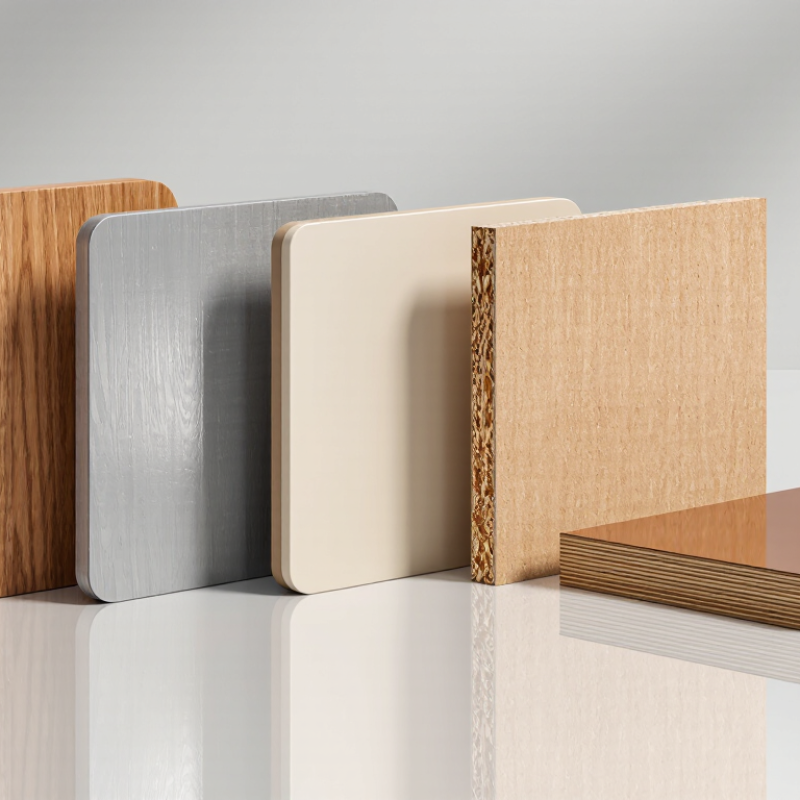
What Defines a Decorative Board in 2026? Core, Surface, and Finish
A decorative board is more than a patterned face. Its performance comes from three linked choices: the core, the surface, and the finish. The core provides stability and support. Medium-density fibreboard gives a smooth base for detailed finishes, while particleboard can suit many cost-conscious interior applications. Plywood may offer stronger screw-holding, depending on its construction. None is automatically best. Match the core to the panel’s location, load, and exposure to moisture.
Then inspect the surface. Melamine and high-pressure laminate can provide practical, consistent coverings; wood veneer offers natural grain, with variation from sheet to sheet. Touch matters, too. A textured surface can make a wood pattern feel more convincing, but grooves may collect dust. Check samples in the room’s actual light. Warm lighting can shift a pale finish toward yellow. Small details count. Look closely at edges, corners, and cutouts, where chips or mismatched patterns are easier to notice.
Finish determines the final appearance and affects care. Matte surfaces tend to soften reflections, while gloss can make marks and fingerprints more visible. Ask how the panel handles routine cleaning, and follow the supplier’s care guidance. A weakness in this checklist is that one sample cannot show how an entire batch will vary. Requesting multiple pieces may help, though it adds time. The “best” board depends on use, not just appearance.
How Top Board Cores Compare: MDF, Particleboard, and Plywood
A decorative board can look identical on a showroom panel yet behave differently once cut, screwed, or exposed to humidity. The core matters. MDF uses fine wood fibers, creating a dense, even face that suits paint and routed details. Its smooth surface is a real advantage. But MDF is heavy, and ordinary grades can swell when water reaches an unsealed edge.
Particleboard is made from larger wood particles bonded into a panel. It is often a practical choice for flat cabinetry and laminated finishes, especially when cost and consistent thickness matter. Its edges can crumble around fasteners, though, and repeated screw removal may weaken the fixing. A small chip at a cut edge can also show through thin coverings.
Plywood layers thin veneers with alternating grain directions, giving it useful strength for shelves, cabinetry, and parts that need reliable fastening. Quality varies with veneer grade, glue, and construction, so “plywood” alone tells little. Check the panel’s intended use, moisture rating, emissions information, and surface compatibility before specifying it. One judgment call remains: the strongest core is not automatically the best one. A painted cabinet door may favor MDF, while a frequently loaded shelf may need plywood; particleboard can still make sense beneath a durable laminate.
How HPL Wear Is Classified: EN 438 AC1–AC6, up to 8,500 Cycles
What Are the Top Decorative Boards in 2026?
HPL wear ratings help compare decorative surfaces under abrasion. EN 438 groups resistance from AC1 to AC6. The scale rises from about 500 cycles for AC1 to 8,500 for AC6. Higher figures indicate better performance in the specified abrasion test. They do not predict an exact service life.
The middle classes offer useful reference points: AC3 is rated at 2,000 cycles, AC4 at 4,000, and AC5 at 6,000. A kitchen work surface may face frequent wiping, grit, and sliding objects. A bedroom panel usually sees less friction. Match the class to expected use, not just appearance. There is a catch.
Abrasion is only one measure of durability. Moisture, impact, heat, cleaning products, and edge quality also affect how a board performs. Check the product’s full technical data and intended-use guidance before specifying it. Cycle counts come from controlled testing, not everyday kitchens or shops. A high rating can be reassuring, but treating it as a complete durability score would be misleading.
Formaldehyde Benchmarks: TSCA Title VI Caps MDF at 0.11 ppm
Decorative boards in 2026 range from veneer-faced MDF to laminate-faced panels and plywood. The best choice depends on the room, finish, and expected wear. For MDF, formaldehyde emissions deserve close attention. TSCA Title VI sets an emission limit of 0.11 parts per million for MDF. This is a panel-emissions benchmark, not a reading of indoor air. The distinction matters.
Look for clear compliance information on the panel or its accompanying documents. A supplier should be able to identify the product type and provide applicable testing or certification details. Read the label. If the board will be cut, inspect the exposed core and seal edges as the product instructions recommend. A smooth, glossy face can hide a rougher substrate underneath.
Meeting the limit does not mean zero emissions. Not zero. Indoor exposure also depends on ventilation, room size, and other materials in the space. I sometimes focus too heavily on the number; it cannot tell the whole story. For a bedroom cabinet or a small office, compare the board’s documentation, finish durability, and installation guidance. Keep the paperwork, too. It is easy to lose once panels are cut and installed.
What Are the Top Decorative Boards in 2026?
TSCA Title VI formaldehyde emission limits for common composite wood panel categories
Lower limits indicate stricter emission thresholds. These are regulatory limits in parts per million (ppm), not measurements of individual products. Source: U.S. EPA TSCA Title VI.
How to Match Board Type to Use: Moisture, Wear, Emissions, and Cost
In 2026, the best decorative board is the one suited to its location, not simply the most attractive sample. Melamine-faced particleboard is often a cost-conscious choice for dry wardrobes and shelving. Painted MDF offers a smooth finish for doors and panels, while plywood can suit furniture that needs stronger screw-holding. For splash-prone areas, consider moisture-resistant grades, sealed edges, or compact laminate. No board is invulnerable.
Moisture changes can cause wood-based panels to swell or move, as described in the USDA Forest Products Laboratory’s Wood Handbook. Keep untreated edges away from standing water, especially beneath sinks. Edges matter most. For wear, check the panel’s surface specification against real use: chair backs, bags, and frequent cleaning can quickly mark a low-durability finish. A sample viewed under showroom lights may not reveal that.
Emissions also deserve a close look. Under EPA TSCA Title VI, formaldehyde limits are 0.09 ppm for particleboard, 0.11 ppm for MDF, and 0.05 ppm for hardwood plywood. Ask suppliers for compliant-product documentation, not just a vague “low-emission” claim. Cost includes installation and replacement, not only the board price. A cheaper panel can become expensive if its cut edges absorb water or its finish wears early. I would still inspect the edge in person; specifications do not show every weakness.